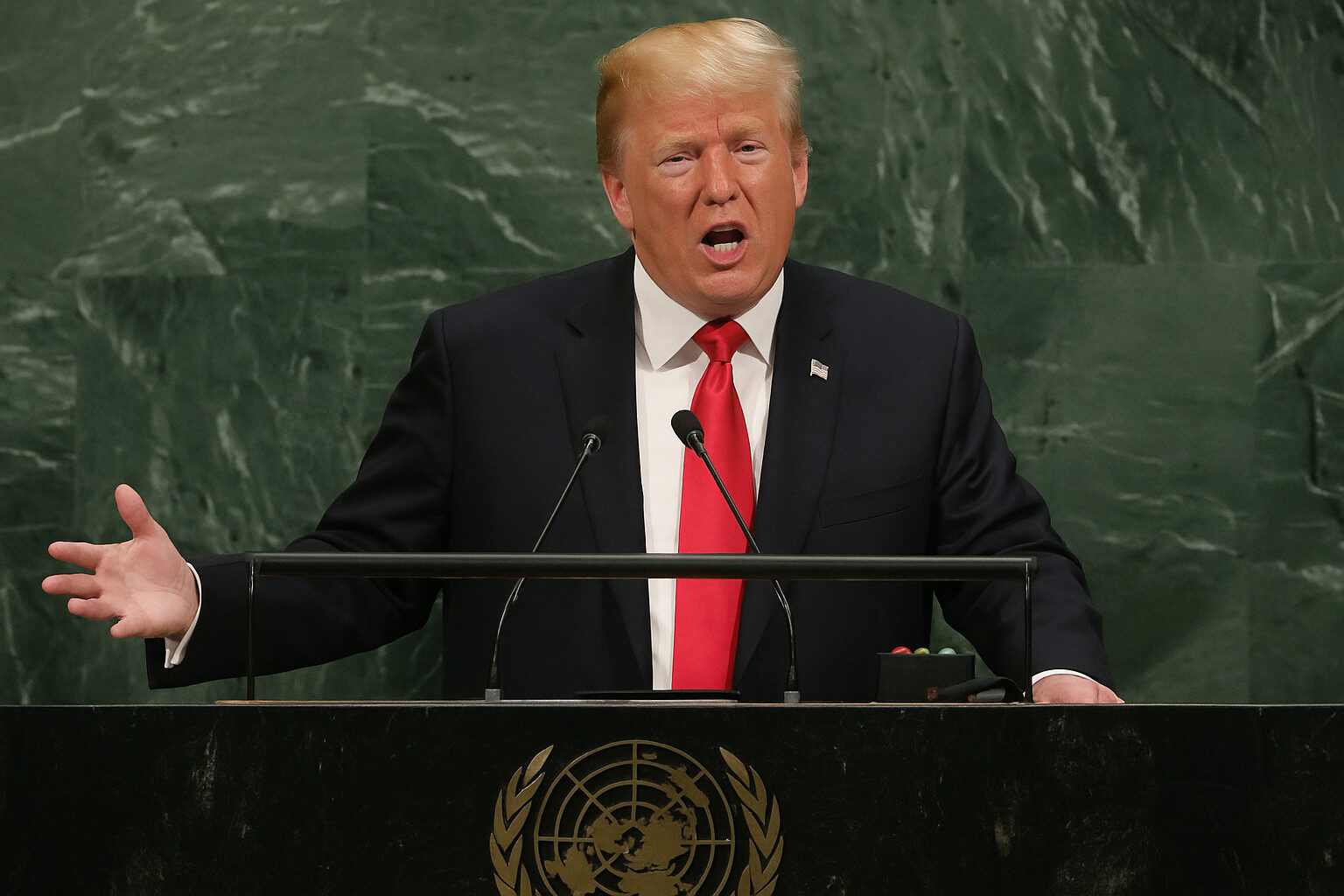
When U.S. President Donald Trump took the stage at the United Nations General Assembly on September 24, 2025, he didn’t deliver a measured statesmanlike address. Instead, he unleashed a blistering attack on America’s allies, accusing them of “destroying” their own nations and warning, “Your countries are going to hell.”
The fiery remarks instantly dominated global headlines, signaling once again how Trump’s rhetoric continues to shape—and divide—the international political stage.
What Did Trump Actually Say?
Speaking before world leaders in New York, Trump criticized NATO members and European allies for what he called weak leadership, uncontrolled immigration, and declining economic strength. According to Al Jazeera’s coverage, he argued that European countries have been undermining their own stability with poor border control and overreliance on global institutions.
Trump’s blunt warning—“You’re destroying your countries, your cultures, your civilizations”—was met with a mixture of gasps, laughter, and stunned silence in the UN hall.
Why Is This in the News Now?
This speech comes at a pivotal moment in world politics. Europe is grappling with a fresh migration surge triggered by conflicts in Ukraine, the Middle East, and North Africa. Meanwhile, economic growth in the Eurozone has slowed to under 1% in 2025, according to Eurostat, fueling populist movements across the continent.
Trump, who is once again the Republican presidential frontrunner, has seized on these vulnerabilities. His UN speech doubled as both an international warning and a domestic campaign pitch—underscoring his America-first stance and contrasting it with what he calls Europe’s “suicidal policies.”
Historical Context: Trump vs. Allies
This is not the first time Trump has scolded America’s allies. During his presidency (2017–2021), he repeatedly accused NATO members of failing to meet their defense spending commitments. In 2018, he even threatened to withdraw the U.S. from NATO unless countries increased military funding.
What makes his latest remarks stand out is the intensity of his language. Where previous presidents sought to reassure allies, Trump once again cast doubt on the strength of Western unity—at a time when Russia’s war in Ukraine and rising tensions with China make international cohesion more critical than ever.
The Implications: Fractures in the Western Alliance
Analysts say Trump’s comments risk deepening divisions between the U.S. and Europe.
- Diplomatic trust: European leaders, already wary of Trump’s unpredictability, may question whether the U.S. would stand firm in NATO under his leadership.
- Political fuel: Right-wing populist leaders in Europe could use Trump’s words to bolster their own campaigns, pushing policies on immigration and sovereignty.
- Global rivals: Russia and China benefit when cracks appear in Western alliances. Moscow, in particular, has long sought to weaken NATO solidarity.
According to Pew Research polling, trust in U.S. global leadership fell by nearly 30 percentage points during Trump’s first term and has only partially recovered since. His latest speech could accelerate a similar decline if he wins re-election.
Practical Takeaway
For ordinary readers, the key lesson is this: international politics doesn’t just play out in UN speeches—it has direct consequences for energy prices, security guarantees, and even migration policies that affect daily life. If U.S. and European alliances weaken, everything from defense spending to economic stability could shift dramatically.
Trump’s UN speech may have been aimed at rallying his political base, but its impact stretches far beyond campaign soundbites. By telling allies their countries are “going to hell,” he underscored both the strength of his populist message and the fragility of Western unity.