
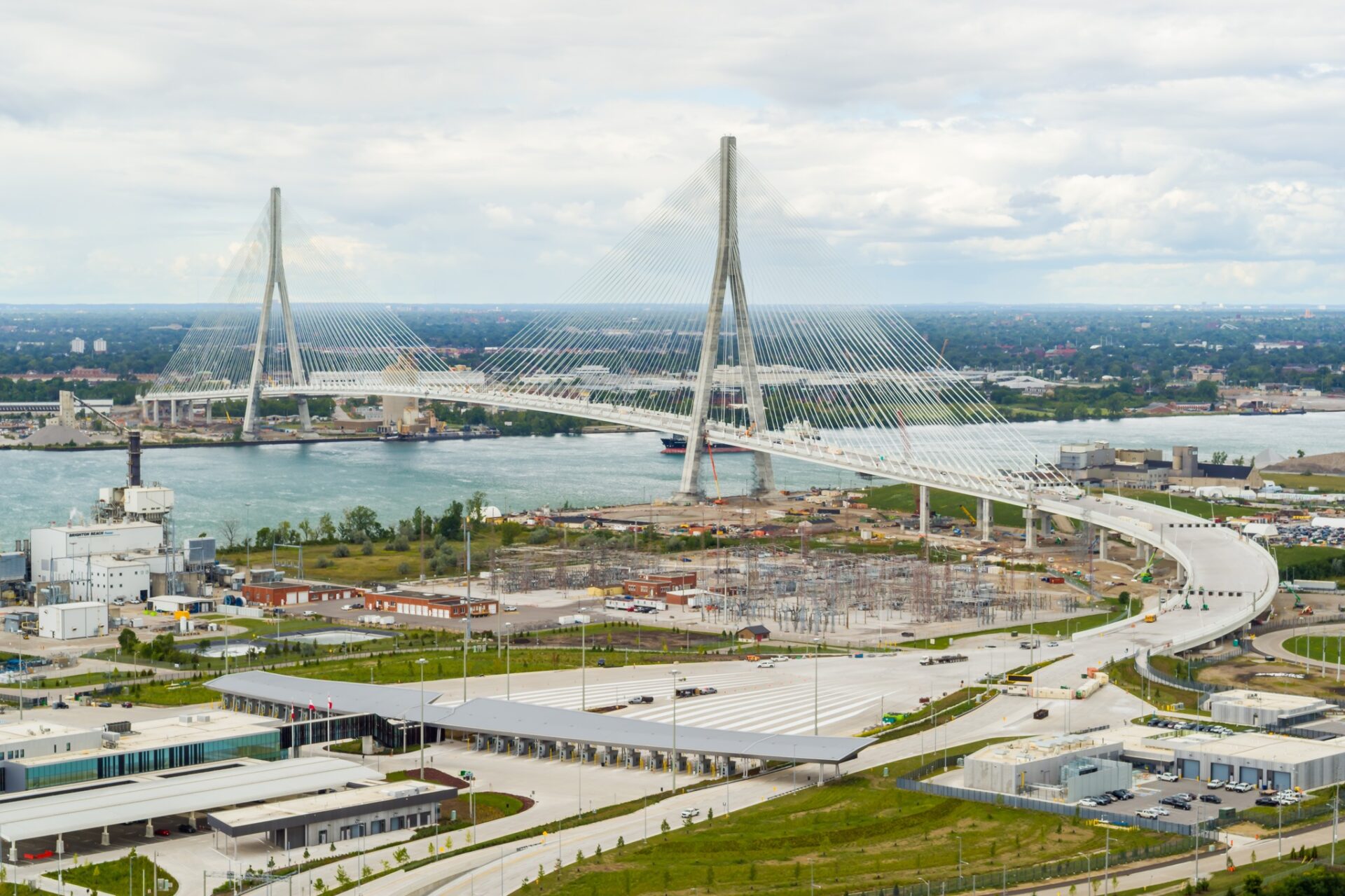
The geopolitical temperature in North America spiked when U.S. President Donald Trump threatened to block the opening of the Gordie Howe International Bridge, a landmark piece of infrastructure linking Windsor, Ontario and Detroit, Michigan, unless Canada accedes to a list of his demands – including granting the United States “at least one half” ownership of a bridge that Canada financed in full. The Trump blocks Gordie Howe bridge ultimatum has sent shockwaves through diplomatic channels, trade markets, and corridor supply chains, raising questions about the future of bilateral cooperation and cross-border investment.
The threat is not just procedural brinkmanship, it carries real economic and strategic risk. The Gordie Howe International Bridge is expected to become one of the busiest commercial gateways in North America, reducing congestion at existing crossings, cutting delays for freight, and unlocking efficiencies worth billions of dollars over decades. Critics of Trump’s move warn that blocking the bridge’s opening could undermine U.S. industry competitiveness, disrupt supply chains, and escalate a broader U.S.-Canada trade conflict already simmering over tariffs and market access.
A Bridge Built by Canada, Threatened by Politics
The Gordie Howe International Bridge project was first agreed upon in 2012 when the Ontario and Canadian federal governments offered to finance the entire cost after the U.S. declined to contribute cash at the time. Construction began in 2018 and the bridge, with an estimated total cost of around $4.6–$5.7 billion, is slated to open in early 2026. Canada funded the construction and negotiated the deal, agreeing to recoup costs through toll revenues.
Legally, the asset’s ownership structure on paper is designed to be 50/50 between Canada and the state of Michigan, but that split reflects governance arrangements more than upfront investment. In practice, Canada paid 100 percent of the project cost and will collect tolls to recoup its investment, while Michigan’s participation enables U.S. operational jurisdiction and integration into interstate highway networks.
In his Feb. 9, 2026 statement on Truth Social, President Trump argued that the United States should be “fully compensated for everything we have given them” and claimed that Ottawa owed the U.S. respect and fairness, including granting the U.S. a larger ownership share before he would “allow this bridge to open.”
Why Now? Trade Tensions and Strategic Posturing
The threat to block the Gordie Howe bridge opening is not isolated, it is embedded in a wider pattern of Trump’s confrontational trade posture towards Canada during his second term. Ottawa’s ongoing disputes with Washington include:
- Tariffs on U.S. dairy products and calls for more market access;
- Ontario’s retail decisions excluding some U.S. alcohol products;
- Canada’s recent preliminary trade negotiations with China which Trump has repeatedly criticized.
Trump’s blockade threat reflects his broader agenda of using trade leverage to extract concessions. By linking a vital infrastructure project to unrelated trade grievances, the administration appears to be signaling that infrastructure — even when fully funded and operationally beneficial — is subject to political bargaining at the highest level.
Policy analysts note that this approach can introduce uncertainty into long-term planning for multinational supply chains, logistics firms, and regional economic strategy, as predictable border access and infrastructure functionality are foundational to North American trade flows.
Backlash from Stakeholders on Both Sides
Across both countries, Trump’s announcement triggered immediate pushback:
Michigan political leaders from both major parties condemned the move, arguing that blocking the bridge would harm workers, increase costs for local businesses, undermine secure supply chains, and erode years of bipartisan support for cross-border infrastructure. Senators and representatives emphasized that the bridge is “a boon to the state’s economy” and criticized the president for placing “personal grievances over regional prosperity.”
In Canada, reactions have been mixed but wary. While federal officials have largely refrained from detailed comment pending diplomacy, Windsor’s mayor described the threats as “just insane” in local discourse. Canadian analysts point out that Ottawa stands to recover its investment over time through toll revenue and that the project’s success has been a rare point of cooperation in an otherwise strained bilateral context.
International business groups and the Canadian Chamber of Commerce have also warned that using infrastructure as a bargaining chip could chill investment sentiment and deter private sector confidence in future cross-border projects.
What Happens Next
From a procedural standpoint, the opening of the Gordie Howe International Bridge is contingent upon final commissioning tests, official designation as a port of entry, and border agency operational readiness – milestones already underway ahead of the scheduled early 2026 launch.
However, if the Trump administration attempts to use federal regulatory authority to delay the bridge’s certification or condition its operation on negotiated concessions, it could prompt legal challenges from Michigan, Canadian authorities, and potentially industry groups. Legal scholars note that federal control over ports of entry and infrastructure siting is well established, but tying those authorities explicitly to extraneous trade demands could set novel precedents.
In Ottawa, officials will have to balance domestic political expectations with diplomatic strategy, ensuring that Canada’s investment and reputation are not undermined while maintaining constructive cross-border economic relations.
Larger Implications for Canada and North America
For Canada and Canadians, the dispute touches on several core concerns:
- National sovereignty over strategic assets paid for with Canadian funds;
- The reliability of U.S. policy commitments where economic interests diverge;
- The potential risk of retaliatory measures affecting exports and labour markets.
Trade analysts warn that escalating tit-for-tat disputes could dampen Canada’s overall economic outlook if other infrastructure projects or market access agreements become politicized. For Canada’s auto sector, agriculture exporters, logistics firms, and port operators, uncertainty at a major crossing like the Gordie Howe bridge could ripple through cost structures and competitiveness.
For U.S. operators, the threat to block a bridge that facilitates a significant share of North American freight flow raises concerns about unexpected policy risk. Disrupted border infrastructure adds friction costs, could push freight onto less efficient crossings, and may strain just-in-time supply strategies that many manufacturers rely upon.
Looking Forward: Negotiation or Escalation?
The Trump blocks Gordie Howe bridge controversy underscores a pivotal moment in Canada-U.S. ties. If negotiations unfold constructively, it may reaffirm the robustness of bilateral mechanisms to resolve disputes without sacrificing key infrastructure. If the standoff deepens, it could signal a departure from longstanding patterns of cooperation, injecting volatility into trade relationships and cross-border economic planning.
What unfolds will matter not just for Windsor and Detroit, but for the future architecture of North American integration, where infrastructure, trade policy, and geopolitics increasingly intersect. In that sense, the bridge – a symbol of connectivity – has suddenly become the focal point of a significant diplomatic and economic test between two of the world’s most interlinked economies.
Sources:
Yahoo News:Trump threatens to block opening of US-Canada bridge – Yahoo News Canada
Reuters: Trump threatens to bar new US-Canada bridge from opening, demands talks with Ottawa
Wikipedia: Gordie Howe International Bridge