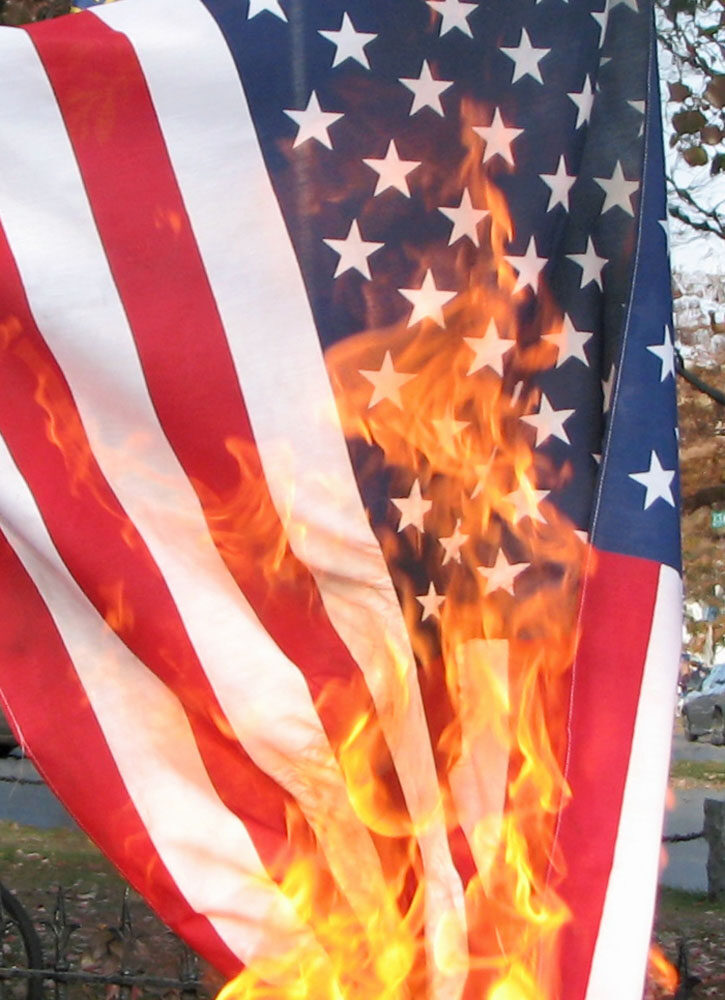
On Monday evening, just hours after President Donald Trump signed an executive order targeting flag desecration, a decorated Army veteran staged a bold act of defiance: he burned an American flag outside the White House. The incident ignited fierce debate across the nation—raising questions about patriotism, freedom, and the boundaries of protest.
The veteran, identified as 54-year-old Jay Carey, a Bronze Star recipient from North Carolina, declared his action a constitutional protest, firmly grounded in his experiences serving the country. “It was my right as a citizen,” Carey said during the demonstration. The Secret Service arrested him for lighting a fire on federal parkland, but released him after four hours in custody. Carey stated he intends to escalate charges, hoping to challenge the executive order in court rather than let it stand.The Washington Post
Trump’s Order Meets Its Most Vocal Critic Yet
Devised as a swift response to recent protests where flags were burned amid anti-Israel and pro-immigration demonstrations, Trump’s executive order directs the Justice Department to investigate and prosecute cases of flag desecration—even those previously ruled protected under free speech laws. Trump boldly declared that flag burners should face “one year in jail,” framing the act as incitement to violence and a direct affront to American values.
Legal experts and civil rights groups wasted no time calling the move unconstitutional, pointing to the landmark 1989 Supreme Court ruling in Texas v. Johnson, reaffirmed in United States v. Eichman (1990), which firmly established flag burning as protected symbolic speech. Critics also flagged misinformation in White House communications, notably Trump’s claim of a mandatory one-year sentence—a detail omitted in the order itself—and flagged with community notes on social media.
A Veteran’s Message: Service, Protest, and the First Amendment
For Carey, the act wasn’t about defiance for its own sake—it was rooted in principle. A combat veteran who has lost comrades in service, he sees his protest as a final stand for the very freedoms he once defended. “I will go to jail,” Carey told reporters, framing his act as a symbolic test of whether America still honors the constitutional protections he risked his life to uphold.The Washington Post
The Stakes: Free Speech Versus Symbolic Offense
This incident has thrust the clash between symbolic patriotism and constitutional liberty into the spotlight. On one hand, flags represent the collective sacrifices and values of the nation. On the other, history affirms that constitutional freedoms must sometimes protect gestures—even those that offend—to maintain a healthy democracy.
Trump and his supporters argue that flag burning goes beyond expression—it can provoke violence, fracture unity, and dishonor veterans. But legal scholars warn that criminalizing it risks undermining the very liberties the flag stands for.
A Nation Watching
- Supreme Court spotlight ahead: Carey’s case could push the issue back to the justices who defined flag burning’s legal protections.
- Polarization deepens: Political divisions grow as supporters of Trump’s “zero tolerance” face off with defenders of free expression.
- Citizens watching vigilantly: The scenario poses a defining question—do we protect symbols unquestioningly, or uphold foundational rights, even in defiance?